
As a homework assignment, use Maple to find all critical points for the functions specified, and classify each point as relative max, min, saddle point, or neither. As before, you do not need to turn in a Maple worksheet, but instead list, for each of the four functions, all critical points and specify the values of d and if necessary f_xx for these points, together with your conclusion about whether the points are max/min/saddles.
a) f(x,y) = 2*x^2 + y^2 + 8*x - 6*y + 20
b) f(x,y) = -x^3 + 4*x*y - 2*y^2 + 1;
c) f(x, y) = y^3 - 3*x*y^2 - 3*y^2 - 3*x^2 + 1
d) f(x, y) = x*y / ( (x^2 + 1)*(y^2+1))
Here is an example of how you could use Maple to find and classify critical points of a function in two variables.
First, we define the function:
> f(x, y) := -x^3 + 4*x*y - y^2 + 1;
Next we find the first partial derivates, which we store in symbols f_x and f_y
> f_x := diff(f(x,y), x);
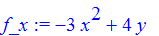
> f_y := diff(f(x,y), y);

We also find the four second order partials (acutally only three, since f_xy and f_yx are identical for this function (why?)
> f_xx := diff(f(x,y), x, x);
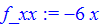
> f_yy := diff(f(x,y), y, y);

> f_xy := diff(f(x,y), x, y);

Finally we define d (the descriminant) as d = f_xx * f_yy - f_xy^2
> d := f_xx * f_yy - f_xy^2;

Now we can find the critical points by solving the system of equations as follows:
> solve( {f_x = 0, f_y = 0}, {x, y});
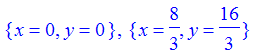
We therefore found 2 critical points. For each point I have to use the second derivate test to decide whether it is a relative minimum or maximum. I have to evaluate d and (if d > 0) f_xx at each of these points.
> subs(x=0,y=0, d);

Therefore the critical point (0, 0) is a saddle point.
> subs(x=8/3, y=16/3, d);

> subs(x=8/3, y=16/3, f_xx);

Therefore the point (8/3, 16/3) is a relative maximum.
Finally, we graph the function to see approximately whether our answers could be right
> plot3d(f(x,y), x = -1..1, y=-1..1);
![[Maple Plot]](images/maple_max_min12.gif)
It is not easy to see the maximum here, so we "zoom in" around the maximum to get a better view:
> plot3d(f(x,y), x = 8/3-0.2..8/3+0.2, y=16/3-0.2..16/3+0.2);
![[Maple Plot]](images/maple_max_min13.gif)
> restart;
>