#1
Awaiting
a Compromise on YouTube
By
JOE NOCERA
Published: March 17, 2007
“Viacom
is so ticked off at YouTube,” my son Nick informed me not long ago. “It’s just
so obvious.”
Scott Barbour/Getty Images
Eric Schmidt, Google’s chief, says his company
“respects copyright.”
Nick, who is a senior in high school, knew this not
because he reads the business pages; like most 17-year olds, he doesn’t. He knew
it because he is a YouTube fanatic, and has a keen understanding of the rhythms
of the online video site. For months, he had been able to watch clips of “The
Daily Show With Jon Stewart” or “The Colbert Report” on YouTube — shows that
were produced by Viacom’s Comedy Central channel.
Suddenly, though, he couldn’t get access to them.
They had disappeared from YouTube, as had most of Viacom’s other copyrighted
fare, like “SpongeBob SquarePants” and “
So upset that this week Viacom filed a $1 billion
copyright infringement suit against YouTube and its parent, the mighty
Google, which last year bought the tiny start-up for a jaw-dropping $1.65
billion. At that point, YouTube was a fledgling company with no profits and
negligible revenue. But it had already become the site for posting — and
watching — short user-generated digital videos. Most of the videos on YouTube
really are generated by users — there are lots of spoofs and home videos and the
like on the site. But there are also plenty of users who are “generating”
content by slapping up shows, or portions or shows, that are owned by the big
media companies like Viacom. Shows like, well, “The Daily Show With Jon Stewart”
and “The Colbert Report.”
At first glance, the Viacom lawsuit may seem like a
carbon copy of the music industry’s fight against
Napster in the late 1990s. Old-line industry sees new threat from the
Internet and tries to sue it into oblivion. But it’s not. In that earlier case,
the music industry won the battle only to lose the war. Although the courts
decisively ruled that Napster was infringing copyrights owned by the big music
companies, that decision didn’t exactly eliminate the practice of stealing
copyrighted music from the Internet. All it meant, in practical terms, was that
youths had to find other, more shadowy sites to use to download music. Pandora’s
box having been opened, it couldn’t be shut again.
The Viacom suit is about something a good deal more
complicated. Just as getting music from the Internet is here to stay, so is
downloading videos. All the big media companies understand that. They all
realize that the Internet has created potential new methods for distributing
their shows — and that creates both great possibilities and great pitfalls. They
all fully understand that they are not going to be able to litigate YouTube off
the face of the earth.
The fact that Google owns YouTube gives the small
company leverage Napster never had.
So the big media companies are all grappling with how
to deal with YouTube. Ultimately, they all want money for their content, no
matter how it is distributed or by whom.
Some companies, like
CBS, have decided that honey catches more flies than vinegar. Its approach
has been to play nice with YouTube, and do small deals in the hopes that it can
eventually work out something big. (It is putting March Madness on YouTube, for
instance, in a deal sponsored by
But Viacom has decided that the only way to deal with
Google and YouTube is to sue. In talking about its suit, Viacom officials use
phrases like the sanctity of copyright, and they speak harshly about what they
see as Google’s and YouTube’s willful misuse of their property. But really,
their goal isn’t all that different from CBS and Time Warner. Viacom wants money
for its content. The only real question is whether this suit will get it for
them.
“Google respects copyright,” insisted Eric Schmidt,
the chief executive of Google. In fact, he told me a few days after the suit was
filed, “we need copyright to be effective because we don’t make our own
content.” In Mr. Schmidt’s opinion, even though YouTube doesn’t prevent users
from posting copyrighted material on the site, that doesn’t mean the company is
ignoring the law. On the contrary. “We are governed by a law called the
D.M.C.A., and we are in compliance with that,” he said.
One of Mr. Schmidt’s great qualities is that he
always sounds like the voice of sweet reason. You come away from an interview
with him wondering how anyone could possible think that “Do No Evil” Google
could be less than fully engaged in protecting the copyrights of others. As Mr.
Schmidt points out, the Viacom suit came “in the context of a business
negotiation” in which the two companies were trying to work out a deal. From
Google’s point of view, the lawsuit is little more than effort to gain some
increased leverage in the negotiations. And it most certainly is that.
But when you look at it a little more closely, you
realize that it is also about those initials Mr. Schmidt used a few paragraphs
ago. D.M.C.A. stands for the Digital Millennium Copyright Act, a 1998 law that
governs how Internet companies are supposed to handle copyrighted material. At
its core, the lawsuit is about whether the D.M.C.A. should favor Google’s
approach to copyrighted material, or Viacom’s.
Paradoxically, the law was originally intended to
help the big media companies, which, in the wake of Napster, were terrified that
they were losing their ability to control their copyrighted material. But it
also had an important sop to Internet service providers: it said that they
shouldn’t be held responsible if people used their service to post copyrighted
content. What they had to do, however, was promise to remove such content
immediately when a copyright holder complained.
This is what Mr. Schmidt means when he says that
YouTube is abiding by the law. YouTube doesn’t police its site because its
doesn’t have to, under its interpretation of the D.M.C.A. But whenever a
copyright holder complains, it removes the offending material. The reason you
don’t see much Jon Stewart on YouTube anymore is that Viacom has been
complaining — a lot.
But from Viacom’s point of view, it is ridiculous
that it should bear the onus of finding the offending material and asking
YouTube to remove it. “To say that the D.M.C.A. protects a company like YouTube
when they systematically show copyrighted material is an extremely twisted
interpretation,” said Philippe P. Dauman, Viacom’s chief executive. According to
Viacom, YouTube has allowed tens of thousands — nay, well over 100,000 — of its
copyrighted clips to be posted on the site. The company claims it is spending
more than $100,000 a month hunting them down and asking that they be removed.
Can this really be the intention of the law?
One provision of the D.M.C.A. is that in order to be
held harmless for copyrighted content, an Internet company has to have no
knowledge that the content is on the site. Google, of course, says that it has
no idea whether material on YouTube is being posted illegally or not. But here’s
where Viacom goes completely ballistic. Surely, it says, YouTube knows that
Viacom’s material is on the site — everyone knows how popular Jon Stewart is to
YouTube viewers. “If you are aware of copyrighted material being put up and you
are profiting from it, then you have an affirmative duty to do something about
it,” Mr. Dauman said. He also complained that Google was willing to filter
copyrighted content — but only with companies that cut deals with it.
One of the things you realize when you begin to talk
to people who care about copyright law is how fervent they can get. For much of
the technorati, Viacom is a dinosaur that doesn’t understand the new world — or
the power of YouTube to act as a marketing vehicle for their shows.
“YouTube has become a brilliant promotional platform
for video content,” said Roger McNamee, the technology investor. “How can it be
bad that all the Comedy Central stuff is on there?”
Lawrence Lessig, the law professor at Stanford who specializes in copyright
issues, said that YouTube “allows people to signal what is interesting and what
is valuable.” If Viacom, he went on, “thought about how to leverage the value
instead of trying to stop it, they would be better off.”
But from the Viacom side, the issue is simple: It’s
their property, and they should get to decide who to give it to and how much to
charge for it. “The law says this is our material,” said Michael Fricklas, a
company lawyer. “Google is saying, ‘We’ll take it and then we can have a
business discussion.’ ”
The problem for both sides is that copyright law is
not nearly as black and white as Google and Viacom are making it out to be. It
is filled with compromises and ambiguity. People have always been able to use
small amounts of copyrighted material without asking permission, for instance.
And though both sides insist that the law is on their side, it is impossible to
know right now how a judge might ultimately rule.
Which is where the real danger lies for both sides.
Victory would be sweet, but losing could be disastrous. If Google wins, YouTube
will never have to pay much to anyone for copyrighted content, and companies
like Viacom will wind up either handing over their material or continuing to ask
that it be removed — again and again and again. Smaller companies — not to
mention the artists themselves — will probably have less control over their own
work. If Viacom wins, YouTube will no longer be able to allow copyrighted
content to be posted — which will surely hurt its business prospects. And it
will make it more dangerous for any Internet site to use copyrighted material —
even when it is legal to do so.
That’s why, as adamant as they sound now, it is
highly likely that Google and Viacom will figure out a way to settle their
dispute — and in so doing set an example for everyone else trying to figure this
out. Sometimes, a little ambiguity isn’t such a bad thing.
Tips
To find reference information
about the words used in this article, double-click on any word, phrase or name.
A new window will open with a dictionary definition or encyclopedia entry.
Past Coverage
#2
Public outrage over crime has
found political expression in the proposal and enactment of various laws
mandating lengthy sentences for repeat felons. Put forward under the slogan
"three strikes and you're out," these laws generally prescribe that felons found
guilty of a third serious crime be locked up for 25 years to life. The
In November, Californians will vote on Proposition
184, an initiative essentially identical to the new three-strikes law.[1]
Should Californians approve the initiative and so ratify the legislature's
action? Or should they reject it, sending the message that legislators should
reconsider the new law, perhaps in favor of an alternative mandatory-sentencing
measure? What about other states? Should they follow
In reaching a decision, Californians will naturally
be affected by a variety of subjective factors, for example, fear of crime,
sympathy for victims and their families, and anger at violent criminals. But
voters should also have access to hard evidence regarding the implications of
the law: How much crime reduction can they expect from the three-strikes law?
And how much will it cost? What about the alternatives? And where will the money
come from?
What Will Be the Benefits and
Costs of the New Law?
If fully implemented as written,
the new law will reduce serious felonies committed by adults[2
]in
This reduction in crime will be bought at a cost of
an extra $4.5 billion to $6.5 billion per year in current dollars. The intent of
the three-strikes law is, of course, to lock up repeat offenders longer, and
that requires the construction and operation of more prisons. Some police and
court costs may be saved in not having to deal so often with such offenders once
they are locked up, but greater prison costs overwhelm such savings.
What About the Alternatives?
The new three-strikes law has
been criticized by some for casting too wide a net. It is argued that the public
is not really as concerned about minor felonies or even residential burglaries
as it is about truly violent crimes and that it will not want to pay to keep
less violent felons locked up. Indeed, the
In view of the width of the "net" and the power of
the less-publicized provisions of the new law, could an alternative be
constructed in which some benefit would be sacrificed to achieve great savings?
What if there were no third-strike provision? Or, what if the extended sentences
applied only if a violent felony were committed? What about one of the
alternatives considered by the legislature, the "Rainey bill," which would have
been harsher on violent felons and more lenient on others? Finally, what would
happen if the state got rid of "strikes" and instead guaranteed that those
convicted of a serious crime serve their full sentence? In other words, what
about adopting a law that sends all those convicted of a serious felony to
prison, eliminates "good time" for such felons so that they must serve their
full term, and shifts some minor felons from prison to probation?
Figures 1 and 2 compare the benefits and costs of the
new law and these alternatives, relative to the old law. As you might expect,
for the most part, the more focused alternatives would be both less costly than
the new law and less effective at reducing crime.[3
] But some of them would not be much less effective. For example, the
second-strike-only alternative would be 85 percent as effective as the new law.
This has an interesting implication: Only 15 percent of the new law's crime
reduction effect will come from its most publicized provision--the third strike.

Figure 1--Percentage reduction in serious crime
from new law and alternatives
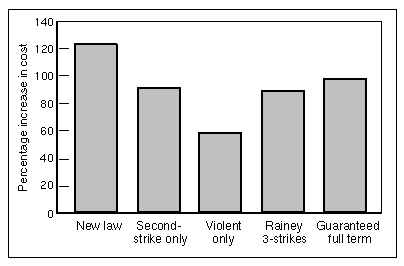
Figure 2--Percentage increase in cost from new law
and alternatives
But for all the alternatives to the new law, the cost
would drop more than the effectiveness. For example, applying the new law's
penalties only to violent felons would save half its extra cost but retain
two-thirds of its effectiveness.
Cost-effectiveness, though, is not necessarily the
most important criterion. To some people, a reduction in serious crime on the
order of 30 percent would be attractive no matter what the cost. However, it
seems unlikely that anyone would want to pay more for that than they had to. In
this context, the guaranteed-full-term alternative could be of interest, for it
would be just as effective as the new law at substantially lower cost. The
advantages of this alternative point up the shortcomings of the new law: The
full-term alternative would increase sentences for all serious offenders--even
first-timers who are near the beginning of their criminal careers--and pay for
it by not imprisoning many minor felons. The new law, in contrast, does not
crack down on first-time serious offenders. Instead, it expends large amounts of
money keeping older criminals--including many convicted of minor
offenses--locked up. Data on criminal careers suggest that the term of
imprisonment for many of these older offenders will last beyond the point at
which they would resume a life of crime if released, meaning that costs will be
incurred for no crime-reduction benefit.
Where Will the Money Come From?
The money to finance three
strikes will have to come from somewhere. The choices, however, are limited.
Figure 3 shows the current allocation of expenditures from the state's general
fund. Proposition 98 locked into the state constitution a minimum level of
spending on K-12 education that is expected to increase dramatically in the
coming years--from 36 percent of the general fund now to 47 percent in 2002.
Health and welfare costs have been going up for a long time and show no signs of
leveling off. The new three-strikes law will double the fraction of the general
fund consumed by the Department of Corrections. Clearly, these increases will
put enormous pressure on everything else the state spends money on (see Figure
4). That includes, most prominently, college education, but also a variety of
other services ranging from controlling environmental pollution through managing
parks and fighting brush fires to regulating insurance and other industries.
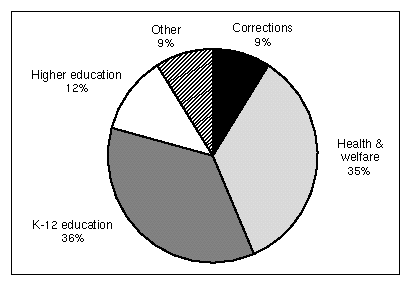
Figure 3--Distribution of California General-Fund
Appropriations, FY94
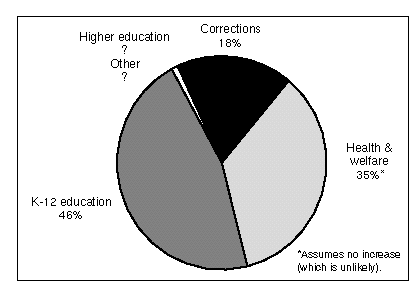
Figure 4--Budgetary Squeeze on Higher Education
and Other Services, FY02
It seems unlikely that Californians will put up with
drastic reductions in these services, but increased taxes are decidedly
unpopular. Clearly, something's got to give. It may be the three-strikes law
itself. Criminal justice officials may simply not have the money to fully
implement it. If that turns out to be the case, the new law will have less
effect on serious crime than that estimated here. How much less is impossible to
predict.
[1]Passage
of the law in initiative form will prevent repeal or amendment (other than to
further the law's purpose) by the legislature.
[2]Juvenile
offenders will not be affected by this law. They now account for about one-sixth
of all arrests for violent crimes.
[3]For
these figures, we take the estimated benefit and cost of the new law from the
middle of the ranges given above--28 percent and $5.5 billion.
RB-4009