ADDENDUM TO WPA ARTICLE
Appendix C: Faculty Assessment of DSP
A A - B + B B - C + C C - D + D F
So capable that the student really doesn’t appear to need this class
Very capable of doing the work in the class
Capable of doing the work in the class
Marginally capable of doing the work in the class
Incapable of doing the work in the class
Very motivated Adequately motivated
Not very motivated Unmotivated
Appendix D: Student Assessment of DSP
I originally chose to be placed in College English I (ENGL 1201) and also
enrolled in College English I with Reading and Writing Workshop (ENGL
1201-0160).
I originally chose to be placed in College English I with Reading and Writing
Workshop (ENGL 1201-0160) and also enrolled in College English I with
Reading and Writing Workshop (ENGL 1201-0160).
I originally chose to be placed in College English I with Reading and Writing Workshop (ENGL 1201-0160) but in the end chose College English I (ENGL 1201).
I originally chose to be placed in College English I (ENGL 1201) but in the
end chose College English I with Reading and Writing Workshop (ENGL
1201-0160).
Very positive Positive Mildly positive Neither positive nor negative
Mildly negative Negative Very negative
Yes______________________________________________________ __________________________________________________________
No________________________________________________________ ___________________________________________________________
I believe that I placed myself in the correct level English course.
I believe that the placement process gave me an accurate picture of what to expect in my English course.
I did not take the online placement survey that seriously at first.
I spent at least 30 minutes on the online survey essay about gangster films.
Placing myself into the English course has motivated me to work harder or do better than I normally would in English.
I found the placement process clear and straightforward.
College English I is harder than I thought it would be.
Concern about my writing ability
Concern about my reading ability
Concern about my ability to do well in college
Concern about my ability to well in new situations
Having heard about the course from friends
Advice from parents, other family, or counselors
Conversation with Prof. Jones, the director of placement
Confidence in my writing ability
Confidence in reading ability
Confidence in my ability to do well in college
Confidence in my ability to do well in new situations
Concern that the course did not count toward graduation
Having heard about the course from friends
Advice from parents, other family, or counselors
Conversation with Prof. Jones, the director of placement
Success by Cohort
This section provides strong evidence that students who score lower on the verbal SAT and holistically scored placement tests may appropriately place themselves in a regular College English class because they have greater confidence in themselves as writers. p; Table 1 shows that, in general, students who placed themselves into College English I were stronger students—more able, more confident—than those who placed themselves into College English Intensive.
Table 1
Comparison of Significantly Different Predictors of Performance in DSP College English I and College English Intensive Students (n for College English I = 155, n for College English Intensive = 52; except n = 152 and 51 for grades)
|
Variable |
College English I Students |
College English Intensive Students |
|
Course grade (0-4) |
2.93 |
2.59* |
|
# of papers per year in HS |
7.0 |
6.0* |
|
How teacher would rate skills (1-5) |
3.75 |
3.43** |
|
How you rate writing skills (1-5) |
3.67 |
3.29*** |
|
Confidence in completing assignment (1-5) |
4.26 |
3.94** |
|
Confidence you identified main idea of Warshaw passage (1-5) |
3.81 |
3.37** |
|
Confidence you wrote with clear focus (1-5) |
3.62 |
3.20** |
|
Confidence you supported points by referring to text (1-5) |
3.97 |
3.43*** |
|
Confidence you wrote without errors (1-5) |
4.04 |
3.61*** |
|
Holistic score of placement essay |
3.75 |
2.47*** |
|
Verbal SAT |
525 |
479*** |
* Independent samples t-tests indicate that figure is statistically different from that in first column at p <
.02 level.
** Indicates that figure is statistically different from that in first column at p < .01 level.
*** Indicates that figure is statistically different from that in first column at p < .001 level.
However, the dynamics of choice show up much more clearly when the data is analyzed by decision cohort. That is, students made original choices for College English I or College English Intensive; then I evaluated those decisions and, in some cases, questioned them; finally those who were questioned decided to go with their original decision or to switch. There were six such cohorts:
Because there were very few students in the cohorts that ultimately chose College English Intensive, I combined them for the purposes of making statistically significant discoveries. I also deleted the sixth cohort because there were so few of them. The statistically significant differences among the three final cohorts appear in Table 2. The most interesting finding is that among students marginally qualified for College English I, confidence may play a more important role in their success than sheer verbal ability or experience.
Table 2
Comparison of Verbal Ability/Experience/Confidence/Course Grade by Cohort for DSP Students
(n for College English Intensive = 46, n for Unquestioned College English Is = 104, n for
Questioned College English Is = 45)
|
|
Unquestioned College English I Students |
Questioned College English I Students |
College English Intensive Course Students |
Significance* |
|
Course Grade |
2.95c |
2.87 |
2.56a |
.043 |
|
Survey Essay Score |
4.13b,c |
2.90a,c |
2.51a,b |
<.001 |
|
Verbal SAT Score |
537b,c |
504a,c |
480a,b |
<.001 |
|
HS Composite Confidence Score |
11.97c |
11.47c |
10.53a,b |
<.001 |
|
Warshow Composite Self-Assessment Score |
16.02b,c |
14.55a |
13.57a |
<.001 |
|
Number of Books Read |
4.45b,c |
3.71a |
3.82a |
.001 |
|
Number of Papers Written |
7.39b,c |
6.22a |
6.09a |
.002 |
Superscripts designate the cohort(s) from which the given datum differs significantly, based upon Bonferroni or Dunnett’s T3 statistical tests: a = Unquestioned College English I, b = Questioned College English I, c = College English Intensive course.
* Significance refers to p value for the ANOVA, except in cases where variances were not homogeneous. In these cases, the Brown-Forsythe statistic is given.
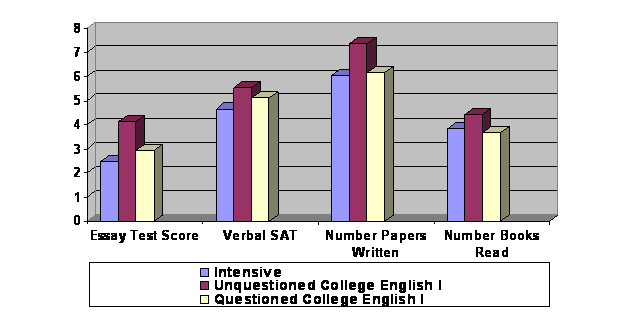
This finding arises from a comparison of the three cohorts. As a group, the Questioned College English I students seem to have an ability profile that more closely matches the College English Intensive student but a confidence profiles that more closely matches the College English Intensive student. (See Fig. 1 and 2.) On the one hand, this should hardly be surprising, since I tended to question those students with low survey essay scores and, to a lesser extent, low verbal SAT scores. Nevertheless, the following analysis suggests that confidence may be what makes the Questioned College English I student succeed on the level of “regular” College English I student despite significantly lower ability and/or less writing experience.
Fig. 1. Comparison of Verbal Ability/Experience by Cohort (n for Intensive Course = 46, n for Unquestioned College English Is = 104, n for Questioned College English Is = 45)
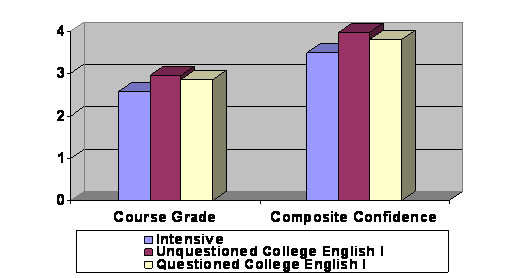
Fig. 2. Comparison of Confidence Levels and Course Grade by Cohort
All College English Intensive students had lower course grades than the Unquestioned College English I group, but while not significantly different, the Questioned College English I students’ course grades were much closer to the Unquestioned College English I students’ than to the College English Intensive students’ (2.95 vs. 2.87 vs. 2.57). However, variables related to academic background like survey essay score or number of books read or papers written show that the profile of Questioned College English I students is more like the profile of the College English Intensive student and that both are different from the Unquestioned College English I students (see Fig. 1): Both Questioned College English I students and College English Intensive students are academically weaker than Unquestioned College English I students and, likewise, they are less prepared academically than Unquestioned College English I students. Significant differences obtain among all three groups’ verbal SAT scores and survey essay scores. These patterns are not true in relation to the High School Composite Confidence score. The Questioned College English I students have confidence more like the Unquestioned College English I students than the College English Intensive students. (Note, however, that Questioned College English I students rated their survey essay more like the College English Intensive student than the Unquestioned College English I student.) Thus it suggests that the Questioned College English I students’ ability to persevere and achieve at a high level may have more to do with confidence, or self-efficacy, than with tested academic performance or previous academic experience.
Online Research: Gender Differences
To illustrate the kind of research that may be done based upon collection of data from online survey that can be a normal part of placement evaluation, I would like to discuss some disturbing trends in relation to perceptions of and success of male vis-à-vis female students. Of the 15 students judged to be marginally capable of doing the coursework, 11 were male. Most telling, male students’ motivation was rated lower than females’ (3.0 vs. 3.36 on a 5 point scale, p = .001). Of the 21 students judged to be less than adequately motivated, 14 were male. The less motivated female students eventually averaged a B-; the less motivated male students scored between a C and a C- (if the two men who did not finish the term are not included). At the end of the term, 9 female students had grades of C or below; 20 male students did. Yet the 14 males labeled less motivated came into the course feeling just as confident, on average, as the 7 females did. Also, of the 14 less motivated male students, 8 received lower than projected grades and 2 withdrew. Of the 7 less motivated female students, only 2 received lower than projected grades. Overall, male students’ projected grades were lower but not significantly (2.65 vs. 2.8), but male students’ final course grades were significantly lower than females’ (2.61 vs. 3.04, p = .004). The shift between the projected grade and the final grade was significantly different for male and female students (p = .027). Yet, overall, male students did not have significantly lower verbal SAT scores or significantly higher survey essay scores, nor did they write fewer papers in high school. They read fewer books and magazines but read more newspapers.
The research related to gender and composition reviewed by Reynolds shows that female students outperform male students in writing from a very young age and that male students are more apt to be apprehensive about writing (94-100). Reynolds thought that the literature was ambiguous about whether male students would be more or less apt to place themselves in College English. On the one hand, they tend to be more confident than their ability would suggest; on the other hand their apprehensiveness might lead to placement in basic writing courses. At Southern Illinois University Carbondale, male students were more apt to place themselves in the less advanced writing course; and the authors concluded this was likely due to male’s greater writing apprehension (Blakesley, Harvey, and Reynolds 226-228). However, they did not control for writing ability. That is, male students could have placed themselves based upon their knowledge of weaker verbal ability, not based upon lack of confidence per se. At Northeastern Catholic University, with writing ability and background about the same, male students were more apt to decide to stay in College English I when I questioned their placement (28 men vs. 22 women). However, the difference in the male and female students’ final grades in this cohort was similar to the difference in grades for the entire DSP population.
These findings raise more questions than do answers. Why should a group of male students who are as well prepared, able, and confident as female students perform more poorly in their first-year writing course? Are young men simply not as interested in writing—or in the subjects that they are writing about, or in writing classrooms—as women? Do faculty perceptions of male students have to do with something beyond verbal ability or achievement? Do faculty perceptions of lacking motivation influence the performance of these male students? Interestingly, both male and female teachers perceived male students to be less motivated than female students. However, whereas male teachers did not grade male students significantly lower than female students (2.72 vs. 2.96, , p = .258), female teachers did (2.53 vs. 3.09, p = .006). Also, male students in female teachers’ classes dropped their grade significantly from their projected grade, where male students in male teachers’ classes did not. Thus, the problem of gender and writing achievement may be compounded by gender and teaching practices.
Appendix F: Means and Standard Deviations for DSP Survey Data
|
Variable |
All Students (n = 220) |
Men (n = 111) |
Women (n = 109) |
|||
|
|
Mean |
Stand. Dev.. |
Mean |
Stand. Dev. |
Mean |
Stand. Dev. |
|
Course grade |
2.85 |
.892 |
2.67 |
.952 |
3.03 |
.794 |
|
Books read/yr. |
4.08 |
1.24 |
3.9 |
1.29 |
4.26 |
1.17 |
|
Newspapers read/wk. |
1.98 |
1.46 |
2.34 |
1.63 |
1.60 |
1.17 |
|
Magazines read/wk. |
1.60 |
1.10 |
1.47 |
1.03 |
1.74 |
1.17 |
|
Number of papers/yr. |
6.81 |
2.43 |
6.83 |
2.31 |
6.79 |
2.55 |
|
HS teachers’ assessment of skills |
3.68 |
.668 |
3.60 |
.704 |
3.76 |
.622 |
|
Your assessment of skills |
3.59 |
.638 |
3.60 |
.664 |
3.58 |
.613 |
|
Ability to complete writing assignment |
4.18 |
.696 |
4.24 |
.677 |
4.11 |
.712 |
|
Composite confidence score |
11.45 |
1.65 |
11.45 |
1.72 |
11.45 |
1.60 |
|
Confidence in identifying main idea |
3.71 |
.815 |
3.77 |
.831 |
3.65 |
.798 |
|
Confidence in having clear focus |
3.52 |
.830 |
3.50 |
.796 |
3.54 |
.866 |
|
Confidence in providing evidence |
3.85 |
.848 |
3.86 |
.883 |
3.85 |
.815 |
|
Confidence in writing without errors |
3.92 |
.801 |
3.90 |
.820 |
3.94 |
.785 |
|
Composite essay confidence score |
15.00 |
2.63 |
15.03 |
2.62 |
14.98 |
2.65 |
|
Essay score |
3.44 |
1.04 |
3.48 |
1.03 |
3.39 |
1.06 |
|
Verbal SAT score |
516 |
46.3 |
512 |
41.5 |
520 |
50.6 |